
The Mirapath Podcast
For data center leaders, rising compute density is not an abstract technology trend. It affects the power, cooling, rack, connectivity, and operational decisions required to move infrastructure into production.
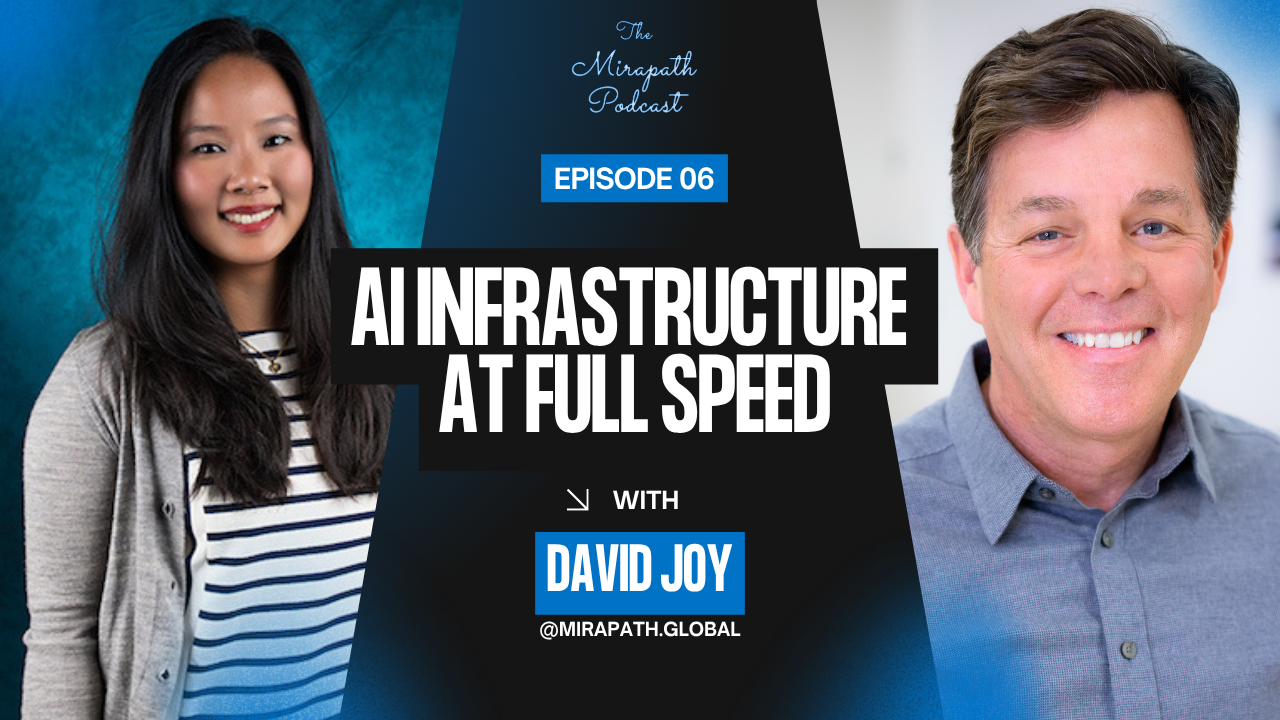
David Joy, Vice President of the Racks, Power, and Cooling Business Units at Rittal LLC, joined The Mirapath Podcast to discuss those changes through the lens of a career spanning more than 30 years in telecommunications and data center infrastructure.
His perspective traces an industry progression from outdoor telecommunications enclosures and comparatively low-density racks to high-density AI environments that can require a different approach to heat removal. The conversation also examines infrastructure investment, responsible technology adoption, and the talent needed to support continued growth.
At a Glance
- Joy describes seeing rack power density rise from below 5 kW earlier in his career to configurations reaching as high as 200 kW in some current AI environments.
- He identifies direct-to-chip liquid cooling as an important response to the heat generated by higher-density compute.
- He encourages infrastructure teams to evaluate whether hardware investment is aligned with practical applications and operational readiness.
- He sees continuous learning, adaptability, and technical curiosity as essential qualities for the next generation of data center professionals.
What Three Decades Reveal About Infrastructure Change
Joy began working with telecommunications infrastructure during the expansion of 3G networks. Outdoor-rated enclosures with integrated cooling helped protect the localized controls supporting new cellular deployments. From there, his career moved through printed circuit board housing, power systems, precision cooling, computer room air handlers, and large fan-wall applications.
That experience gave him a front-row view of both technical change and industry cycles. He recalled periods of rapid expansion around telecommunications and data center construction, as well as contractions following the dot-com downturn and the 2008 financial crisis.
The practical lesson is not that today’s market will repeat any previous cycle in precisely the same way. It is that infrastructure planning benefits from matching investment to defined requirements. Capacity, cooling, serviceability, supply, and application demand all need to remain connected.
Joy applies that same lens to current AI investment. Chip and server capabilities are advancing quickly, but long-term value depends on whether organizations can develop applications and integrate them into real business processes. For infrastructure leaders, the question is therefore broader than how much compute can be installed. It is whether the complete environment can support that compute reliably and at the required scale.
From Room-Level Air Cooling to Heat Removal at the Chip
One of the clearest changes in Joy’s career has been the increase in power concentrated within each rack. He recalled data center racks operating below 5 kW earlier in his career, followed by a progression toward 10 kW, 15 kW, and 20 kW environments. In the podcast, he described some current AI rack configurations reaching 70 kW and, at the upper end, as high as 200 kW.
These figures are Joy’s characterization of the market, and actual requirements vary by equipment, workload, rack configuration, and deployment design. The larger point is operational: as density rises, the cooling architecture may need to change with it.
Joy described the industry’s progression from perimeter computer room air conditioners to chilled-water computer room air handlers and large fan walls. These systems improved the movement and control of air across increasingly dense data halls. High-density AI systems are now pushing heat-removal requirements closer to the processor.
With direct-to-chip liquid cooling, a cold plate captures heat at the chip. The liquid loop carries that heat to a coolant distribution unit, which transfers it into the facility water system for rejection outside the data center. This changes more than the cooling product. It introduces dependencies among the IT equipment, rack, piping, facility water, controls, monitoring, installation, and maintenance strategy.
Infrastructure Planning Must Extend Beyond Individual Components
Joy’s comments underscore a central challenge for AI data center infrastructure: rapid advances in compute can create pressure to make physical infrastructure decisions before every long-term requirement is settled.
That uncertainty does not eliminate the need to act, but it changes how teams should frame the work. Instead of treating a rack, power train, cooling loop, or network connection as an isolated purchase, stakeholders can begin with the workload, deployment schedule, expected density, facility constraints, and operating model.
Define the Real Density Requirement
A headline rack rating does not automatically describe the load that will be deployed on day one or how that load will change. Teams need to distinguish between current operating density, planned maximum density, and the capacity reserved for expansion.
Evaluate the Full Thermal Path
Moving heat from a processor requires an end-to-end path. The cold plate, liquid loop, coolant distribution unit, facility water, controls, and heat-rejection system must be considered together. Maintenance access and operating responsibility matter alongside thermal capacity.
Coordinate IT and Facility Decisions
Higher-density deployments cross traditional organizational boundaries. IT, network, facilities, operations, procurement, and program leadership need a shared view of equipment requirements, site readiness, interfaces, lead times, and acceptance criteria.
Keep Security and Governance in the Conversation
Joy also raised the importance of safeguards developing alongside new technology. His point was not limited to a particular security product or regulation. It was a broader reminder that speed, access, data protection, and responsible use must be considered as organizations integrate AI into business processes.
Building the Talent Pipeline for a Changing Industry
The physical infrastructure behind AI requires people who can connect technical systems with business and operational requirements. Joy’s own route into the industry demonstrates that those professionals do not all need to begin with the same academic background.
He studied marketing and psychology before earning an MBA focused on international business. Throughout his career, he deliberately learned how technologies such as UPS systems, precision cooling, fans, and liquid-cooling equipment operate. That technical curiosity helped him lead within businesses undergoing significant change.
For people entering the field, Joy emphasizes several practical habits:
- Seek education from multiple sources and continue learning as the technology changes.
- Develop enough technical understanding to connect equipment decisions with operating requirements.
- Remain flexible as roles, tools, and infrastructure architectures evolve.
- Consider opportunities throughout the ecosystem, including the companies that design, manufacture, integrate, deploy, and support physical infrastructure.
- Approach technological change with both optimism and responsibility.
These qualities also matter to established teams. Organizations may need to develop knowledge across disciplines, document operating practices, and create opportunities for experienced professionals to transfer practical knowledge to newer entrants.
Key Takeaways
- Rising rack density can affect the entire deployment architecture, not cooling alone.
- Direct-to-chip liquid cooling introduces interfaces that must be coordinated across IT and facility systems.
- Infrastructure investment should remain tied to workloads, applications, site constraints, and operational readiness.
- Cross-functional planning becomes more important as compute, power, cooling, connectivity, and operations become more interdependent.
- Continuous learning and technical curiosity can help professionals from varied backgrounds contribute to the data center industry.
Frequently Asked Questions
What is driving changes in data center cooling?
In the podcast, David Joy connects the change in cooling requirements to rising rack power density. As more heat is concentrated within a rack, infrastructure teams may need to evaluate approaches that move heat closer to its source rather than relying entirely on room-level air cooling.
What is direct-to-chip liquid cooling?
Direct-to-chip liquid cooling uses a liquid-cooled cold plate at the processor to capture heat. Joy describes that heat being transferred through a coolant distribution unit and ultimately into the facility cooling system.
What skills can help someone build a career in data center infrastructure?
Joy emphasizes technical curiosity, continuous learning, adaptability, and a willingness to understand how infrastructure systems work. His own career illustrates that people can enter the field from business as well as engineering backgrounds.